Thursday, July 15, 2010

Organic Cotton Towels - M's and O's

I've fallen behind on my record keeping, so now it's time to catch up! A couple of months ago, I wove a set of kitchen towels in M's and O's, using a 10/2 organic cotton sampler from Chamomile Connection. I needed to make some gift towels, so I wove a set of four. Two were for me to give as (another!) wedding gift. Another was for my grandma to give to her cleaning lady. Grandma is quite fond of her, and she has admired a couple of towels that I have made for Grandma. The last, I kept for myself.
I was inspired to weave these some scarves in a recent issue of Handwoven. They were M's and O's with different stripes in the warp. I thought that would be a good way to use the little bits of different colors that were in the sampler.

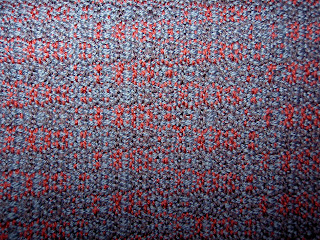
Here is a shot of the towels on the loom. The colors are really subtle.

And here are a couple of the towels after washing in hot water, detergent, and washing soda. The colors are much more vibrant. I used a different color of weft on each towel.

Wednesday, April 28, 2010

Linen Huck Lace Runner

I recently wove a gift for another wedding. This bride is very feminine and traditional. She and her new husband love antiques and have a home that he restored. So, I naturally chose a lace weave for them. I used Bockens 16/2 linen sett at 18 epi. I chose to weave it on my Baby Wolf. I have two reeds that will fit that loom: 8 dpi and 12 dpi. With the 8 dpi, I could sley 2/2/2/3 for 18 epi, and with the 12 dpi, I could sley 1/2 for 18 epi. Thinking it looked more even overall, I chose the 8 dpi reed. In retrospect, I see that this was the wrong choice. I could see reed marks after finishing the runner. I'm sure they weren't noticeable to the bride and groom, but I could see them. I see now that sleying 1/2 would have allowed the warp ends to move more evenly during finishing than the 2/2/2/3 allowed the one odd end en every fourth dent to move. The draft is from page 12 of The best of Weaver's Huck Lace.

I wove a sample as well, and used part of it to make a card to go with the gift:

This was my first experience in weaving with linen. After hearing horror stories about it, I was a little apprehensive, but the apprehension was unnecessary. It behaved very well. I didn't spray the warp with water or soak the bobbins. The weft did have a tendency to jump off the bobbin when it was full. I think either soaking the bobbin or using an EFS would have taken care of that. I should also note that we had a humidifier running in the next room, as we normally do in the winter.

Monday, January 18, 2010

Canvas weave wedding gift

A friend of mine got married a couple of weeks ago. Her engagement was very short, and she didn't give us much notice before the wedding. I'm glad the reception was a week after the wedding, so I had a chance to finish the towels I was making her. There wasn't much time to spend designing the towels as I would have liked, so I just chose a draft from Davison that I had used for towels before. I had woven it before and liked it. It had an interesting pattern and used just one shuttle, so I went with it. It was a canvas weave, Swarthmore Check, on page 69. I used 8/2 unmercerized cotton in green and beige. The label says "KARDED COT 8/2POE". The yarn was pretty friendly to use. The only thing I noticed about it was in the semi-plainweave hems, there was a ton of tracking. That might be fun to play with another time. The towels shrunk noticeably after I washed them, but, of course, I forgot to measure them before I gave them away. I took a piece from the sample and made a card similar to the ones here, but with a heart-shaped opening. I forgot to take a picture of the card, too! I did manage to snap a couple of pics of the towels, so I will leave you with them.

Christmas Cards

I turned those summer & winter bookmarks I was making into Christmas cards. I only finished seven before Christmas, just enough to send to the board members of our guild and to my weaving teacher.

I just stuck the bookmark to the front of a card with some double sided tape and rubber stamped "Peace on Earth" next to it. I thought they turned out fairly well, and a couple of recipients told me how pleased they were. :)

I learned a couple of things. First, I'm glad I used a loom with texsolve heddles because I still several warp ends break. Second, I found out that I didn't really do my research on S&W very well before I started. I had mentioned that I planned to try treadling in x's, o's, singles, and duckagang-fashion. Well, it turns out that real S&W has vertical "blocks" that consist of four picks, ABAB. I designed these with vertical "blocks" that consisted of just two picks, AB. So I just treadled as singles and went with it. If I had more time, I might have played around with it some more, but that darn calendar kept me moving. I think if I weave Christmas cards again, I will weave something that goes a little faster!

Monday, December 7, 2009

"It is more blessed to give than to receive"

It's the time of year in which many of us think about helping those in need. This year, in my town, where the local economy depends heavily on Chrysler and GM, there is no shortage of opportunities to give. I was afraid that this year, having taken a cut in pay, I wouldn't be able to help much, but when I received a list of needs for some local senior citizens, I was inspired. The list included the normal socks, puzzle books, sweatshirts, and... knitting supplies! I immediately thought of my stash of handspun. Over the past couple of years, I have accumulated quite a few skeins for which I had no particular project in mind. So I washed the skeins that looked useable (not my beginnery handspun), wound them into balls, and took them to work to be included in the gift bags for the seniors. I can't tell you how good it felt! After hearing the stories of some of these seniors, many of whom have no family or friends to care for them, I was amazed to think that something I made could touch them.

Earlier this year, I decided to play with echo weave. I wove two scarves on one warp using Mora yan. They turned out pretty well. Since I'm getting to the point where I have more scarves than I can wear, I decided to donate them to a local charity auction, and they were sold this weekend. Those scarves are pictured below:

I was hesitant to write this post because I don't want to pat myself on the back and talk about how good and generous I am. But my hope is that someone may read this and be inspired to use their own talents to reach out to others in their own, individual way. If you aren't sure where to start, I would suggest contacting a local church or the United Way in your area. They can surely direct you to someone who would be encouraged by your gift of fiber (or whatever else). If you have any other ideas for giving, please leave a comment!

Sunday, November 22, 2009

Guild Challenge

This year, our guild's design challenge consisted of drawing three cards. Each one gave instructions with respect to weave structure, color, or fiber. We all had to weave something based on the cards we drew. I had to do plainweave, no more than two colors, and weft heavier than the warp. My first thought after I drew those cards was, "yuck, how boring!" I decided that to make it a little more interesting, I would bend the rules a little, and use several values of one color. Since I have very little experience dying, I consulted "Hands on Dying" and decided to follow the instructions for the first project in that book, which should yield four values of the same color, using Rit or Cushing dye. I thought it would be fun to do some clasped weft weaving with the light and dark colors of weft.

To meet the grist requirements for the warp and weft, I chose some natural 10/2 cotton as warp and some worsted weight cotton as weft. I figured with a heavier weft, I would make some placemats or a table runner. I bought Hobby Lobby brand worsted weight cotton, and I was pretty impressed with it. It is much softer (and I think nicer) than sugar 'n cream cotton, and on sale, it cost less for me to buy several skeins of the Hobby Lobby cotton than it would bave cost to buy a cone of the same weight of sugarn 'n cream. For the dye, I chose Rit in Apple Green.

Anyway, I took the heavy cotton, skeined it, and dyed it according to the instructions in the book. I left the warp cotton natural. A couple of things happened when I did the dying, and, please, keep in mind that I am a very inexperienced dyer. First, the difference in value of each skein was barely discernable. I suspect that this was because the dye I chose to use had a relatively light value to begin with. Since I needed to get moving on the project to meet the due date, I decided just to use what I had and weave something a little plainer without the clasped weft.

The other thing that happened during the dyeing was that when I skeined the yarn, I tied the choke ties too tight. This left some very light spots throughout the skein. Even though this was a mistake, it worked to my advantage. Since the idea of using light and dark yarns to do clasped weft was out, the light spots in the yarn added some interest.

Then I started weaving a placemat in plainweave. It was just OK. The worst part was the selvedges. I don't normally weave with such heavy yarns, and had a horrible time getting nice selvedges. I decided that one placemat of this was enough to fulfill the guild challenge requirements and that I would weave a runner in a different structure. At that point, I wished that I had threaded for rosepath instead of 1, 2, 3, 4. I really didn't want to rethread, so I consulted Davison's book to see what else I could do with that threading. I wove a couple of samples and settled on Joseph France's "Ribs Three & One" on page 7. This was like a plainweave, except three of the warp ends acted as one. I liked the way this looked a lot better, and for some reason, the selvedges looked a lot better with this structure. I'm sure I didn't do anything differently, so I'm not sure what made the difference.

The runner looked fine, but I don't see myself doing much more like that. I'm looking forward to getting back to weaving with some finer yarns. I do think, though, that something similar might be nice for some hand towels since it's nice and soft. I may have to try drying my hands on the runner to see if it's absorment enough. :)
Here are the four skeins after being dyed. You can see a little difference in value, but not much.

Here is the finished placemat, yucky selvedges, and all.

Here is the runner on the loom.

And here is the finished runner.

Tuesday, November 17, 2009

Slow Weaving

I keep hearing about how hot slow art is right now. I think that just about any handweaving and handspinning could be considered slow, but what I'm working on now is ultra-slow! I'm weaving summer and winter bookmarks with 20/2 cotton warp and tabby weft and 10/2 cotton pattern weft on a table loom. It is sett at 36 epi. I chose the table loom for a couple of reasons. First, it's a louet, so it has a raddle that's suited to very fine warp. Second, I like the texsolve heddles for fine warps. If I were to weave this on a floor loom, I would need to use a skeleton tie-up, which would slow down my weaving rhythm considerably, anyway.

This is my first experience with weaving summer and winter. I wanted to make some Christmas gifts, so I designed a draft with little pine trees. I'm thankful to a member of our guild, who put on a program last year about designing with blocks. I had read about this before and vaguely understood how to do it, but to see it explained in person made it much clearer to me. After I had settled on my final design, I was perusing WeaveZine and found a draft there with Christmas trees. I'm glad I found it after I made my own design. While it would have saved me time to use an existing draft, it was good to go through the exercise of designing my own. Besides, I like mine a little better :)

So far, I have one bookmark woven, shown below. It is in the "singles" treadling order, as described by Strickler in her 8-shaft pattern book. My plan is to weave at least one bookmark each in singles, x's, o's, and dukagang-fashion.